-
Version 0.27.0 From control panel to clay diorama
The three faces Copy Shop Panic has had so far, and why it moved from one to the next without touching the game underneath.
Copy Shop Panic has had three faces. The rules never changed: thirty days of June, €8,000 of debt, a queue that loses patience, and a photocopier you have to set exactly the way each order asks. What changed is where you are standing while it all happens.
Version 1: the control panel
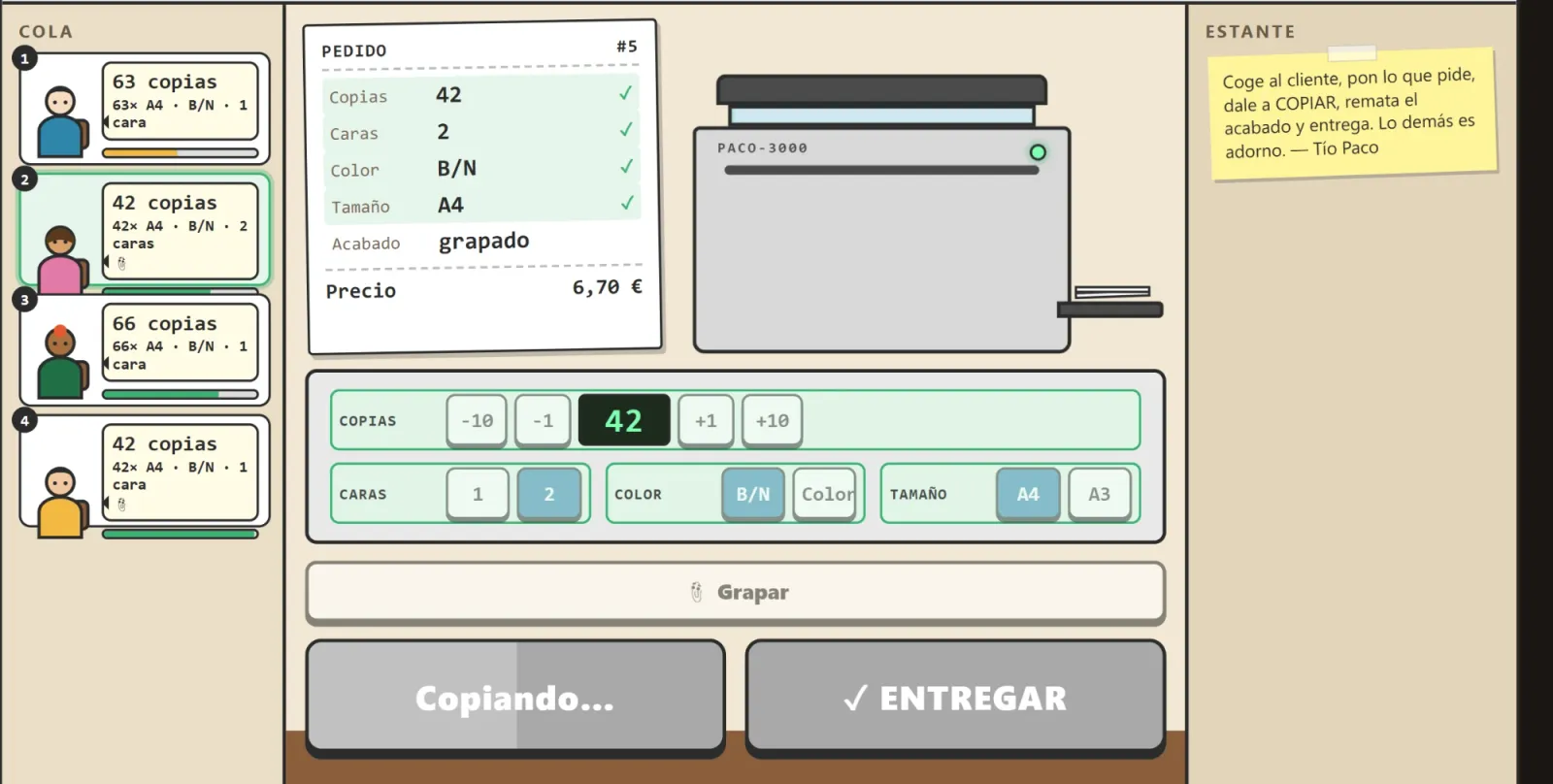
The first version: queue, order, machine and shelf, all on one screen. The first version was a single screen in three columns. On the left, the queue: each customer with a short version of their order and a patience bar. In the middle, the order ticket and the controls of the PACO-3000. On the right, the shelf, with Uncle Paco’s notes.
It was plain on purpose. Its job was to test the only thing that mattered at the start: whether reading an order, setting the machine and hitting copy was any fun. The ticket marks every condition that already matches the machine with a ✓, and the ones that don’t with a ✗.
Almost everything the game has today was built on top of that: the finishes (stapling, binding, cutting), toner and paper that run out, customer types with their own patience and tips, urgent orders, and decorations that raise the tips.
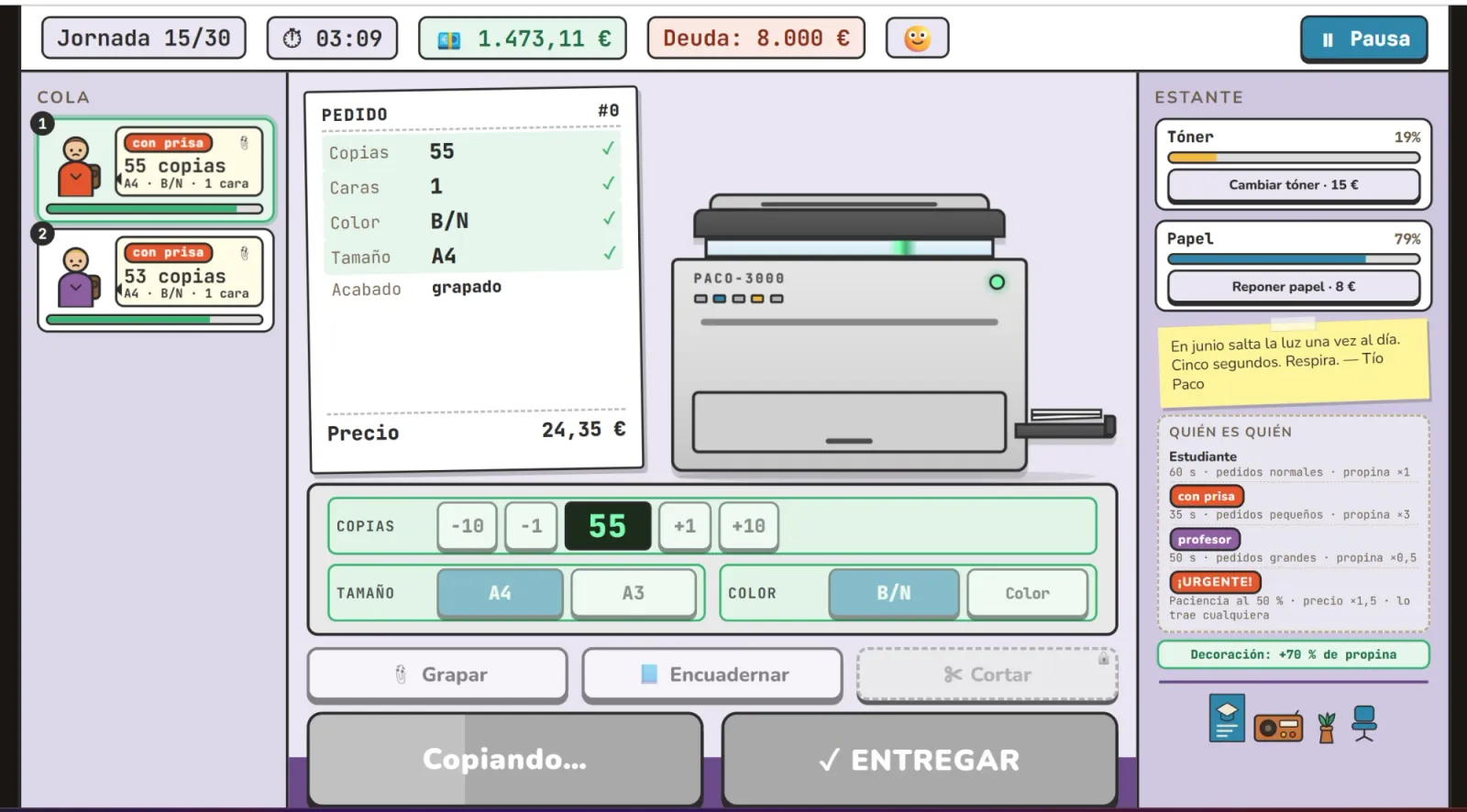
Day 15: toner at 19%, finishes in play, and the debt still untouched. And, above all, the second photocopier, which turns the game into running two orders at once. If one comes out wrong, the ticket tells you what doesn’t match and you run it again.
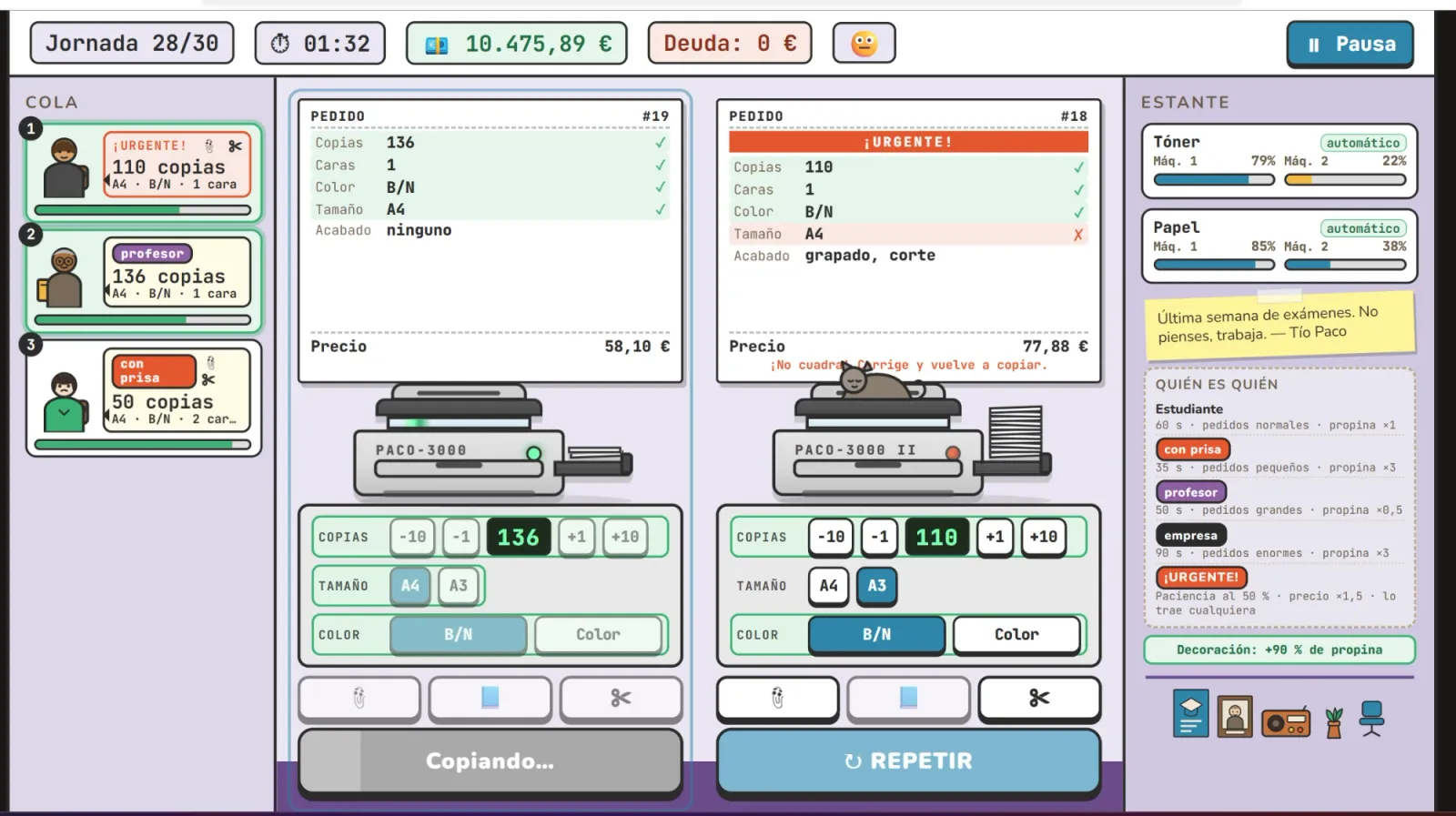
Day 28, with two machines and an urgent order that has to be redone. The cat is a decoration upgrade: it sleeps on the second machine and wakes up when it copies. The game worked, and it was hard to put down. But it looked like a form, it sounded like “beep, beep”, and above all it was far too calm to be called Panic.
Version 2: behind the window
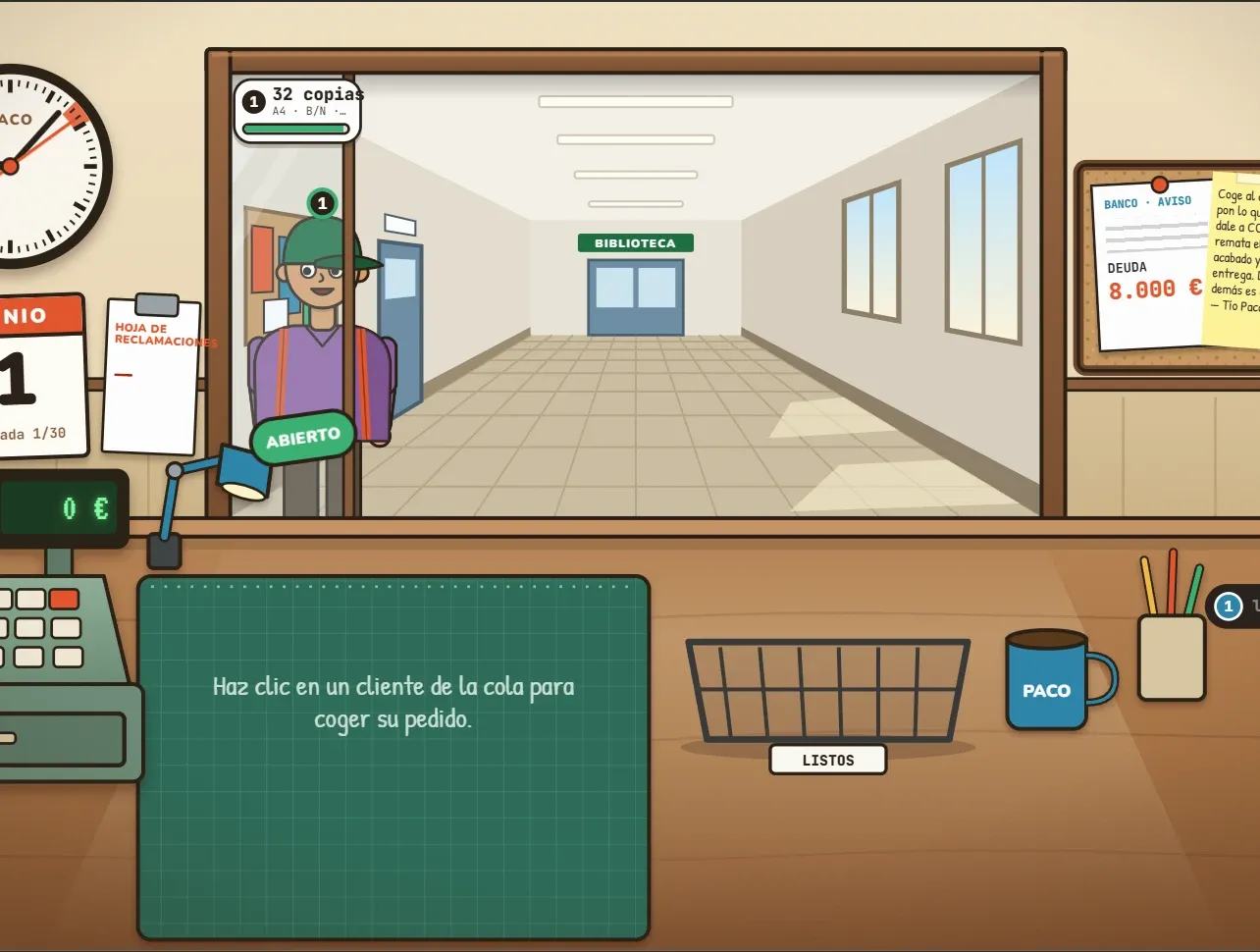
The counter in first person. At the end of the corridor, the library. The second version puts you in first person, behind the counter of a university copy shop. Through the glass you see the faculty corridor and the queue stretching back. Data that used to be loose numbers became objects: the calendar shows the day, the till holds the takings, the bank notice pinned to the corkboard reminds you of the debt, and the complaints sheet waits its turn.
Customers stopped being icons and became people, built from parts — hair, clothes, glasses, backpack — with each type recognisable by its silhouette: the lecturer with glasses and a beard, the company in a suit with a briefcase, Marta with her thesis in her arms. Patience is no longer just a bar: you read it on their faces. They arrive calm, then they frown, then they sweat, and in the end they are fuming.
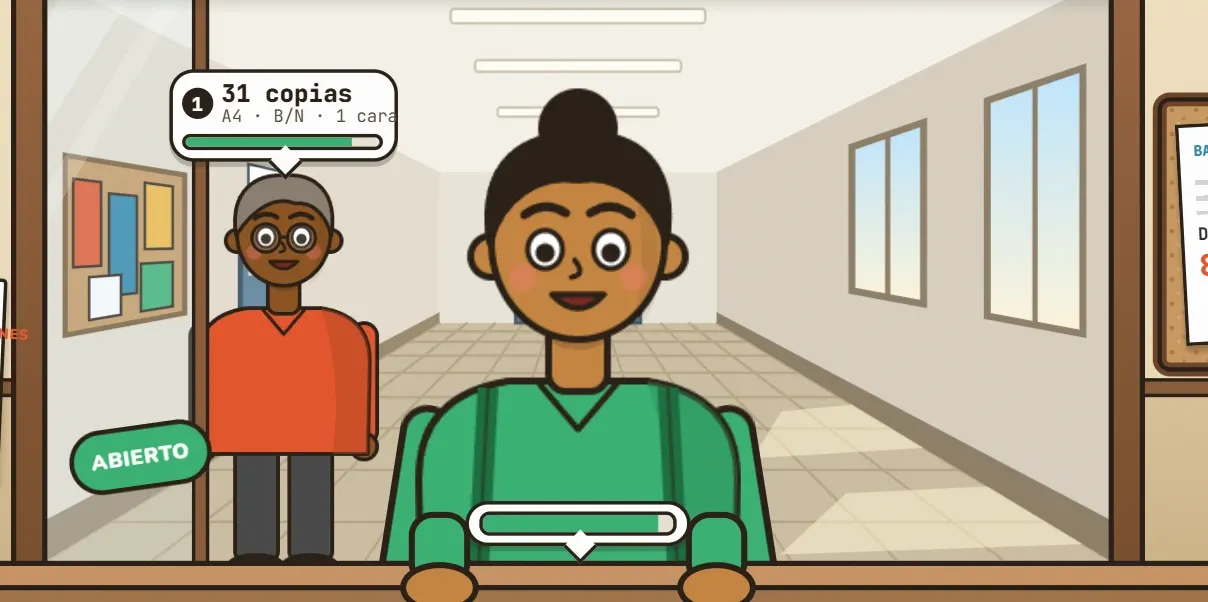
Full-body customers, each with their own patience. The photocopiers moved to the workshop, to the right of the counter, and the camera turns to go from one side to the other. That made room for the upgrades you buy to actually appear in the shop, but it changed the pace of every order, so the timings had to be measured again and the balance redone.
This version also brought the panic — a stress level that rises with every customer who walks out and shows in the shouting, the phone and the red light —, recorded sound in place of synthetic beeps, and Uncle Paco’s guide: a first order he walks you through and one note for every new thing.
Version 3: the copy shop in clay
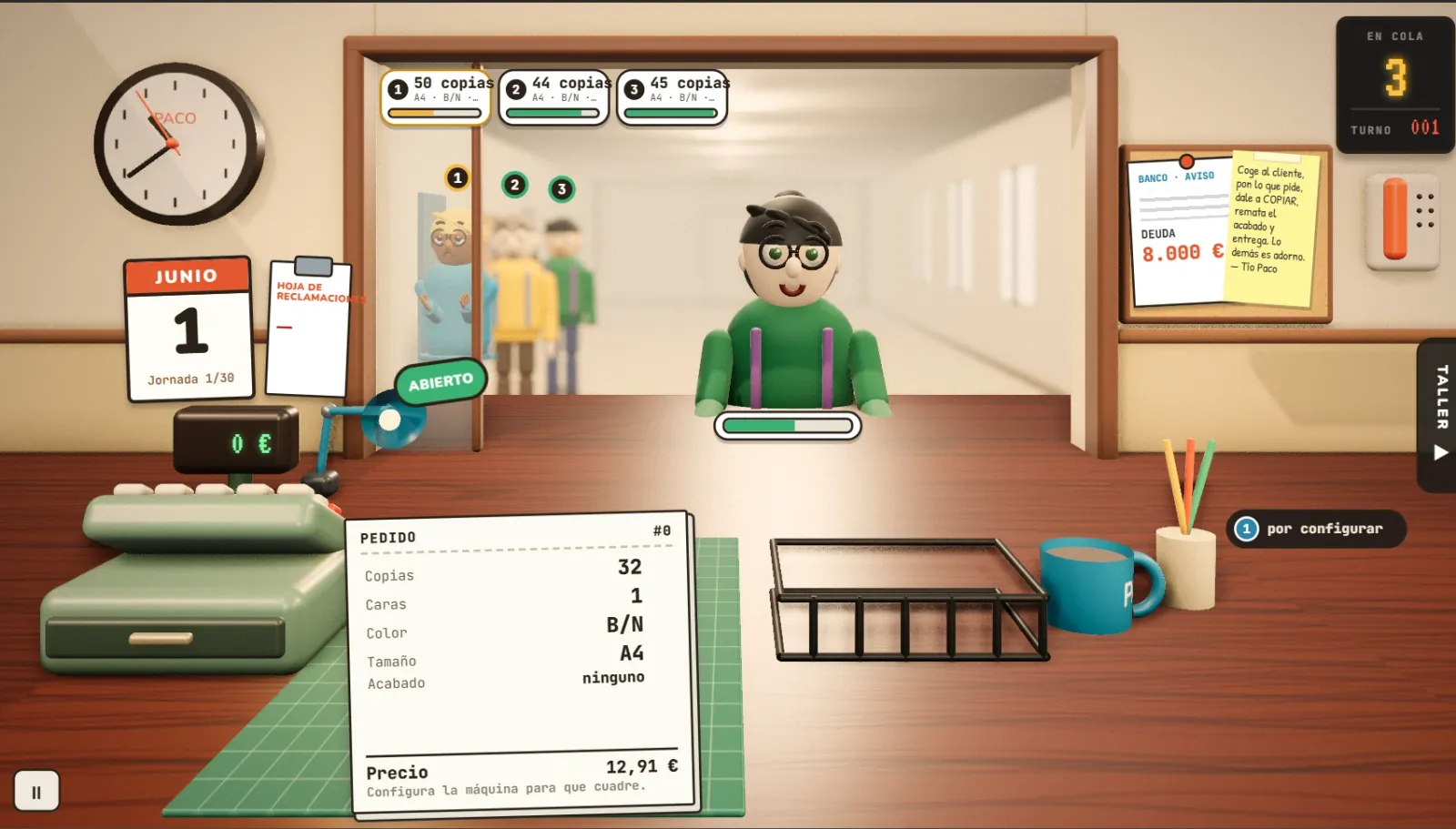
The same counter, now in 3D. The queue blurs into the background; everything you read stays 2D. Version 2 gave the game its personality, but we wanted a finish on another level. The third version is the same copy shop turned into a 3D clay diorama, drawn in real time. There are no hand-made models: every customer, every piece of furniture and every photocopier is built in code, with matte clay materials, warm fluorescent light, soft shadows and the corridor out of focus behind.
The characters are the same ones as in 2D, copied piece by piece. And everything you read or click — tickets, speech bubbles, patience bars, the machine panels — is still 2D on top of the 3D. First it has to be clear; then it can be pretty.
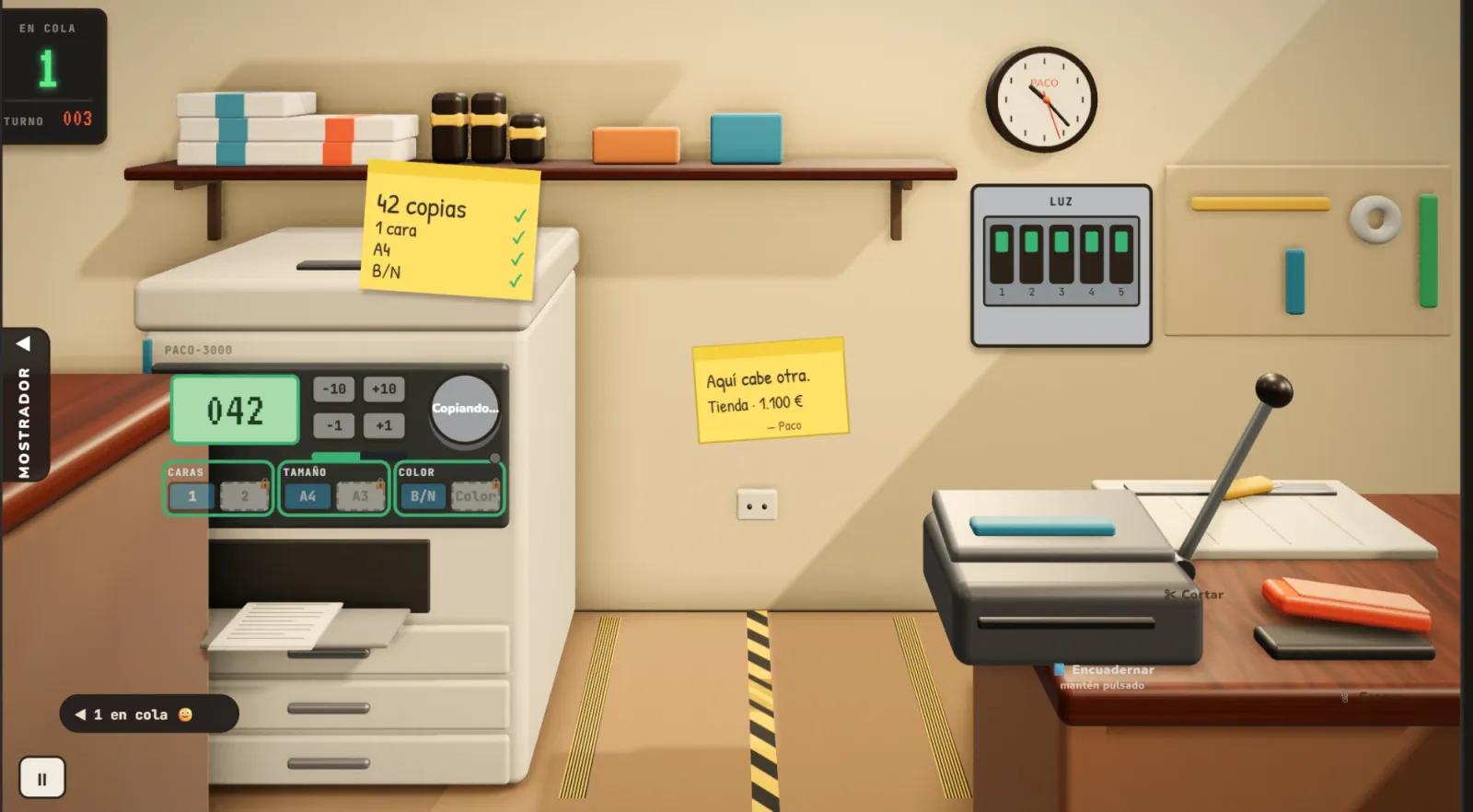
The workshop: the PACO-3000 with its panel, the sticky note for the current order, the fuses for when the power trips, the binder and the guillotine. The workshop was also redone as a wide shot: the machines with their panels, the bench with the tools against the wall, the shelf of spares and the fuse box. Until you buy the second photocopier, its spot waits marked out on the floor, with a note from Uncle Paco.
The 3D is still being built. That is why the game keeps a Graphics setting to choose between 3D and the 2D of version 2: if a computer struggles with the 3D, the game plays exactly the same in 2D.
What hasn’t changed
Three ways of drawing it, one game. The simulation, the economy, Marta’s story and Uncle Paco’s notes all come from the first version, and every change of face has been measured so it doesn’t break the pace of the day. And the PACO-3000 still jams just the same.